AI art is a trust problem
AI art is not automatically bad. It is just dangerous in the wrong layer.
For regulated brands, the wrong layer is usually the visible one: packaging, product photography, claims graphics, founder content, retail displays, and any creative that a customer reads as proof of quality. A cannabis brand can use AI to sketch concepts, organize mood boards, or test directions. The trouble starts when generated art becomes the final public signal.
The brand saves a few hours. The customer sees the shortcut.
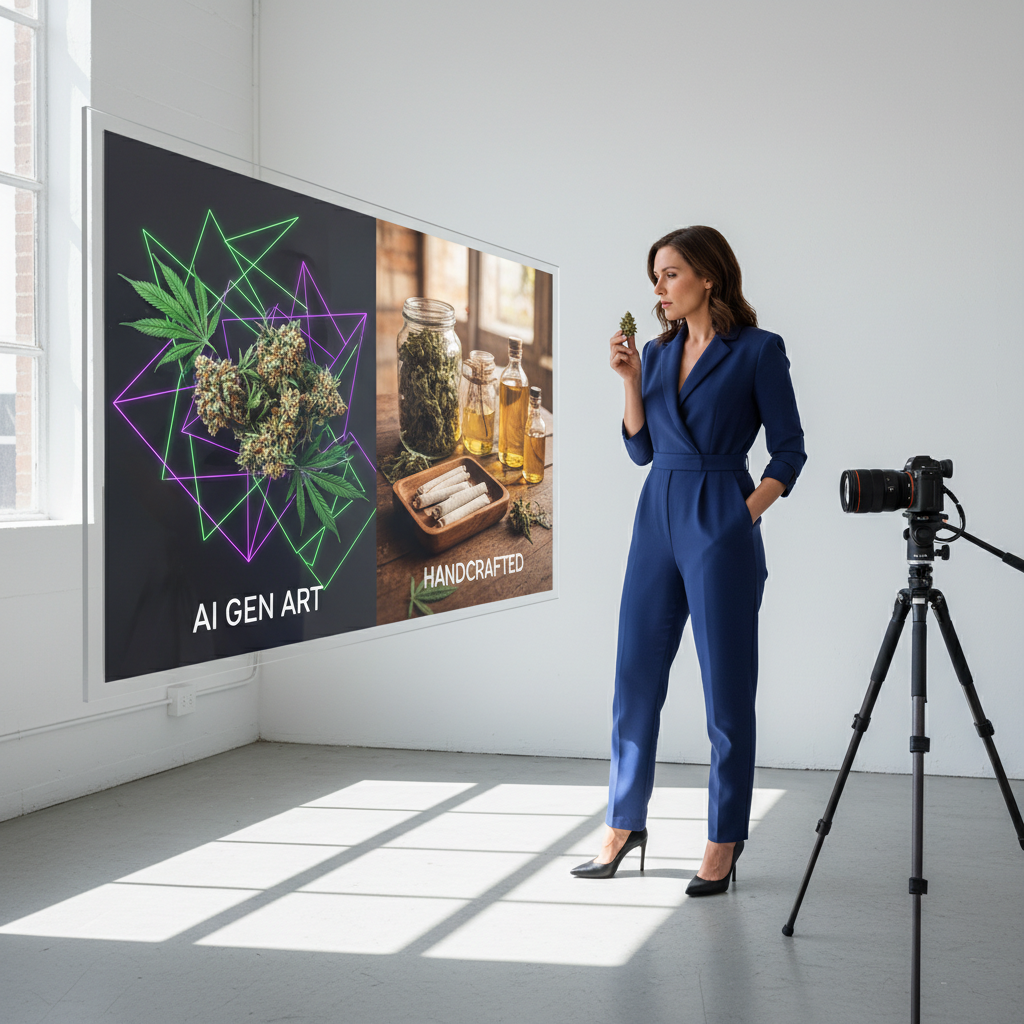
AI-generated creative can be useful as a concept board, but risky as the final brand signal.
The visible layer carries risk
Cannabis, healthcare, finance, alcohol, supplements, and legal services all share the same creative problem: people use visual quality as a shortcut for operational quality. A polished photo, a restrained package, a credible founder video, or a clear compliance graphic tells the buyer that someone is paying attention.
AI-generated art can tell the opposite story when it looks too glossy, too generic, or too detached from the product. That matters because the FTC has warned marketers to keep AI claims in check, and the same principle applies to AI-assisted creative: do not let the image imply proof, performance, safety, authenticity, or endorsement that the business cannot support.
| Visible asset | What customers infer | AI failure mode |
|---|---|---|
| Package art | Craft, quality, shelf intent | Looks templated or uncanny |
| Product photo | Real product, real texture | Misrepresents size, color, or detail |
| Staff or founder content | Accountability | Feels staged or synthetic |
| Claims graphic | Compliance confidence | Implies unsupported benefits |
| Retail display | Brand seriousness | Looks like filler content |
This is sharper in cannabis because the category already fights suspicion. Customers have seen fake reviews, borrowed culture, low-grade wellness language, and brands that overstate product experience. AI art can become another reason not to believe the brand.

The legal issue is not just copyright
Most teams talk about AI art risk as a copyright problem. That is part of it, but it is not the whole risk.
The stronger issue is representation. Does the generated visual imply the product exists in a form it does not? Does it make packaging look more premium than the real shelf unit? Does it show people, stores, lab settings, product effects, or endorsements that are not true? Does it imply a health or performance outcome?
For cannabis brands, the claim risk is bigger than the style debate. A generated wellness scene can accidentally suggest relief, medical benefit, or lifestyle transformation.
A generated product image can show an inaccurate serving, package, warning label, or child-appealing treatment. A generated influencer image can create an endorsement issue if the relationship or artificial nature is not clear.
The FTC endorsement disclosure guide is a useful reminder: consumers need to understand material relationships and sponsored influence. If a brand uses synthetic people, synthetic customer scenes, or AI-assisted creator content, the disclosure question does not disappear because the asset was generated.
The provenance layer matters
The next version of brand governance will include provenance. Teams will need to know where creative came from, what prompt created it, who edited it, who approved it, and what claims the image could imply.
The C2PA specification is one example of the broader push toward content credentials and asset history.
That does not mean every small brand needs an enterprise provenance stack tomorrow. It does mean AI images should not float around Slack with no owner, no source, and no approval record.
For a regulated brand, a lightweight record is enough to start:
| Record | Why it matters |
|---|---|
| Prompt or source note | Shows how the asset was created |
| Human editor | Creates accountability for taste and claims |
| Compliance reviewer | Checks warnings, restrictions, and implied claims |
| Use location | Keeps assets from being reused in riskier contexts |
| Expiration date | Forces stale AI creative out of rotation |
Where AI art belongs
AI art is useful in the workbench. It can help a team compare directions, describe mood, explore shoot concepts, build storyboards, and create rough visual briefs before a designer or photographer starts. That is a good use.
AI art is weaker as the final shelf signal.
The operating split is simple:
| Use AI for | Keep human-owned |
|---|---|
| Mood board options | Final package system |
| Shot list exploration | Product photography |
| Internal concept boards | Claims graphics |
| Thumbnail testing | Founder and staff content |
| Layout variations | Compliance-approved public visuals |

The premium problem
Budget brands can often get away with more synthetic creative because the customer has already chosen price over craft. Premium brands do not have that cushion. Their price depends on the belief that the product, team, and experience are more intentional.
That is why AI art can quietly damage the middle of the market. A premium-adjacent brand uses AI creative to move faster, but the output looks like everyone else's campaign. The brand keeps the price point of craft and the visual language of automation.
That is a bad trade.
The better move is to use AI to make the human work sharper. Use it to condense customer objections before a shoot. Use it to identify which product details customers mention in reviews. Use it to build a better creative brief. Then use real photography, real art direction, and real product detail for the final asset.
This connects to the broader AI-native agency model: automation should remove waste around the work, not erase the taste inside the work.
The asset library needs rules
Most creative problems start in the asset library, not in the campaign. A generated image gets made for one internal brainstorm. Someone later finds it in a folder, assumes it was approved, and drops it into an email, landing page, point-of-sale sheet, or retailer deck. The context changes, but the review record does not travel with the asset.
That is how a harmless concept becomes a public risk.
Regulated brands should treat AI-assisted visuals like claim-sensitive copy. Put them in a labeled folder. Mark draft, approved, internal-only, expired, or do-not-use. Keep the original prompt or source note close to the final asset. Make the default assumption "not public" until a human changes the status.
The less known issue is version drift. A team may approve a safe visual, then crop it, brighten it, add a product callout, or use it beside a headline that changes the implied claim. The visual did not become risky alone. The new context made it risky.
That is why image approval should include placement, not only the file.
| Asset status | Allowed use | Required review |
|---|---|---|
| Draft concept | Internal mood board | Creative lead |
| Internal-only | Briefs, planning, research | Asset owner |
| Public eligible | Website, email, social, retail | Compliance and brand owner |
| Expired | No use | Refresh or delete |
| Do-not-use | No use | Document reason |
This sounds operational because it is. The best creative systems are not just prettier. They reduce the number of ways a tired team can publish the wrong thing on a deadline.
A practical review checklist
Before publishing AI-assisted creative, ask:
- 1Does the image show a real product, package, person, location, or result?
- 2Could a customer reasonably read the image as a claim?
- 3Does the asset need a disclosure, source note, or internal provenance record?
- 4Would the brand still feel proud of the visual if a regulator, retailer, or journalist asked how it was made?
- 5Is a human owner willing to sign off on it by name?
If the answer is fuzzy, use the asset internally. Do not make it public yet.
For cannabis brands, add three more checks: no health implication, no youth-appealing visual treatment, and no mismatch between the generated package and the real compliant package. The cannabis compliance paradox is that the faster content gets, the more disciplined review has to become.
FAQ
No. They should avoid using AI art as final proof when the visual could affect trust, claims, product accuracy, or disclosure. AI is safer for concepting, mood boards, and internal creative planning.
The biggest risk is implied claims. A generated image can suggest product effects, lifestyle outcomes, endorsements, or package details that the brand cannot legally or operationally support.
It can be used during concepting, but final packaging needs human design review, legal review, label accuracy, and state-specific compliance review. The generated concept should not become the public package without that work.
Keep the prompt or source, asset owner, review notes, approval date, use location, and expiration date. A simple record is better than a folder of untraceable AI images.
Use AI before and after the public asset: research, brief creation, concept exploration, review checklists, and performance analysis. Keep final shelf-facing creative accountable to human taste and compliance.