
The compliance gap nobody's talking about.
By Dellon
Published on: July 27, 2026
8 min read
Table of Contents
Your Agent Just Made A Decision You Can't Defend
Your email AI agent ran a test. It segmented your list based on purchase history and engagement patterns. It found a micro-segment that converted at 8x the baseline. Revenue jumped 12 percent.
Your CEO is thrilled.
Then a customer gets an email that feels weirdly targeted. They screenshot it. It goes on Twitter. Someone tags the FTC's AI enforcement team.
And now you have a problem.
Not because your agent did something wrong. But because you can't explain how your agent decided to send that specific email to that specific person at that specific time. You've got logs. You've got performance data. But you don't have a clear, defensible audit trail showing the decision was accurate, not manipulative, and not discriminatory.
This is happening right now to AI agents deployed at scale. Not as rare edge cases. As a regular operational friction.
Where The Legal Gap Actually Lives
The FTC just published a policy statement on AI accuracy and ideological manipulation (comment deadline July 31, 2026). It's the first time the FTC has formally addressed AI output integrity at the marketing level.
What the FTC cares about: Whether your AI system is making decisions based on training data accuracy, whether it's detecting and correcting false claims, and whether it's being deliberately steered toward biased outputs.
What most CMOs care about: Whether the AI agent hits their KPIs.
These two things are not the same. And the gap is growing.
Here's the specific problem: Marketing AI agents make hundreds of micro-decisions every day. Audience targeting decisions. Subject line choices. Send time optimization. Budget allocation. Each decision is logged. But most teams don't have a systematic way to audit whether those decisions were:
- 1Grounded in accurate training data - Did the agent learn from real customer behavior, or did it learn patterns that are correlated but not causal?
- 2Checked against known false claims - If the agent has a taxonomy of prohibited health claims (especially critical for cannabis marketing), is it actively filtering against them, or just hoping they don't slip through?
- 3Deliberately nudged by humans - Are product managers tweaking the agent's reward signals in ways that would look manipulative under FTC scrutiny?
Most teams haven't even defined what auditing these looks like.
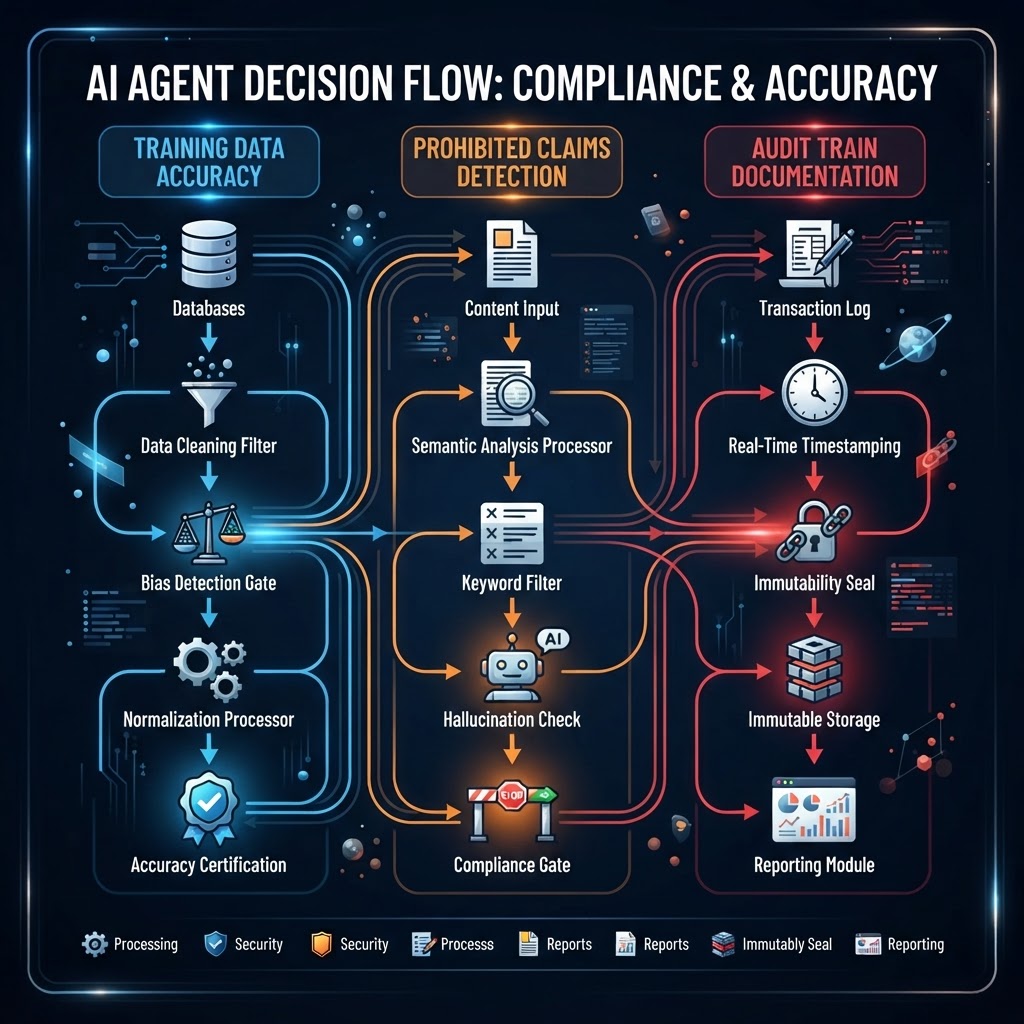
Three critical compliance gates most teams skip entirely.
The Three Compliance Patterns CMOs Miss
Pattern One: The Training Data Audit Gap
Your AI agent was trained on a dataset of past customer behavior. It learned that 30-year-old men in Denver who bought fishing gear in spring are 40 percent more likely to convert on outdoor sports email.
That correlation is real in your historical data. So the agent uses it.
But what if that pattern exists because of a historical product launch that happened to target that demographic, not because of an underlying preference? Now your agent is reinforcing a targeting bias that has nothing to do with actual customer behavior and everything to do with past marketing decisions.
Under the new FTC policy, this is a problem. You're steering customers based on inaccurate training data, not genuine intent signals.
The fix: Before deploying your agent, audit the training dataset for biases and confounds. Document which correlations are causal and which are artifacts. Then build guardrails that prevent the agent from overweighting correlated-but-not-causal patterns.
Nobody does this. Most teams don't even know what datasets their agent was trained on.
Pattern Two: The Prohibited Claims Flyby
This one hits cannabis operators especially hard.
Your cannabis brand's AI agent is writing customer-facing copy. Email subject lines. Ad headlines. Product descriptions. Most of these are fine.
But once a week, the agent generates something that crosses the line into health claims. "Better sleep in three nights." "Reduces anxiety without sedation." Prohibited claims that violate California Advertising Code, FTC guidelines, and platform policies.
Your compliance team catches most of them. But maybe not all. And each miss is a regulatory event waiting to happen.
The gap: Most marketing AI agents aren't trained with a compliance filter. They generate text first, then rely on humans to catch violations. Under FTC scrutiny, this looks like negligence. You're deploying a system that you know generates prohibited claims, and you're only catching them sometimes.
The fix: Build the compliance rules into the agent itself. If your agent is trained on cannabis marketing language, it should learn that certain claim patterns are prohibited and actively avoid them. Use a classification model that flags prohibited claims with 99.9 percent precision, then route those to a human reviewer before they see daylight.
This requires domain expertise and ongoing tuning. It's not sexy. And it's not a default feature in any consumer AI platform.

The manual compliance review process that doesn't scale.
Pattern Three: The Audit Trail Collapse
Your AI agent made 200 budget allocation decisions last week across six campaigns. Revenue was up 8 percent. CFO is asking which decisions drove the uplift.
You can't answer. The agent logged its actions. But the logs don't connect to outcomes. You know the agent increased budget for Audience A on Tuesday. You know conversions went up Wednesday. But you can't prove the second happened because of the first.
Under FTC enforcement, this becomes a nightmare. If a customer complains that they were targeted with misleading information, and you're asked to show the decision logic that led to that targeting, you have no clear record. The agent made a decision. The decision had an outcome. But the audit trail is fragmented across three different systems.
The fix: Implement decision logging at the agent level, not just the platform level. Before an agent makes a targeting decision, it should write a structured decision record: What signal triggered this? What alternatives were considered? Why was this option selected? Then, when a conversion happens, that decision record gets linked to the outcome.
This requires custom engineering for each AI system. Most teams don't have this infrastructure.
Cannabis Operators: This Gets Worse
If you're a cannabis brand deploying an AI marketing agent, everything above is true and then some.
Cannabis marketing has the tightest compliance requirements in marketing. Age verification. Prohibited claims. Platform-specific restrictions (Instagram bans cannabis ads entirely, TikTok requires special licensing). DUI/impaired driving language. Cannabis content can't target minors.
An AI agent operating in this space needs to understand the intersection of:
- 1Regulatory requirements (varies by state, federal restrictions, FTC guidance)
- 2Platform policies (each ad network has its own rules)
- 3Operational constraints (which audiences are reachable without hitting a violation)
Most cannabis operators are using off-the-shelf AI agents designed for general e-commerce. These agents don't have cannabis-specific compliance built in. They can't distinguish between a legal health claim ("CBD is non-intoxicating") and a prohibited one ("CBD will reduce your anxiety").
The result: Cannabis brands deploying AI agents without compliance infrastructure are running regulatory experiments. One agent violation on a major platform can cost you access to that platform. For cannabis brands, platform access is survival.
Related reading: Check out how we've helped cannabis operators navigate AI personalization compliance and detection evasion risks.
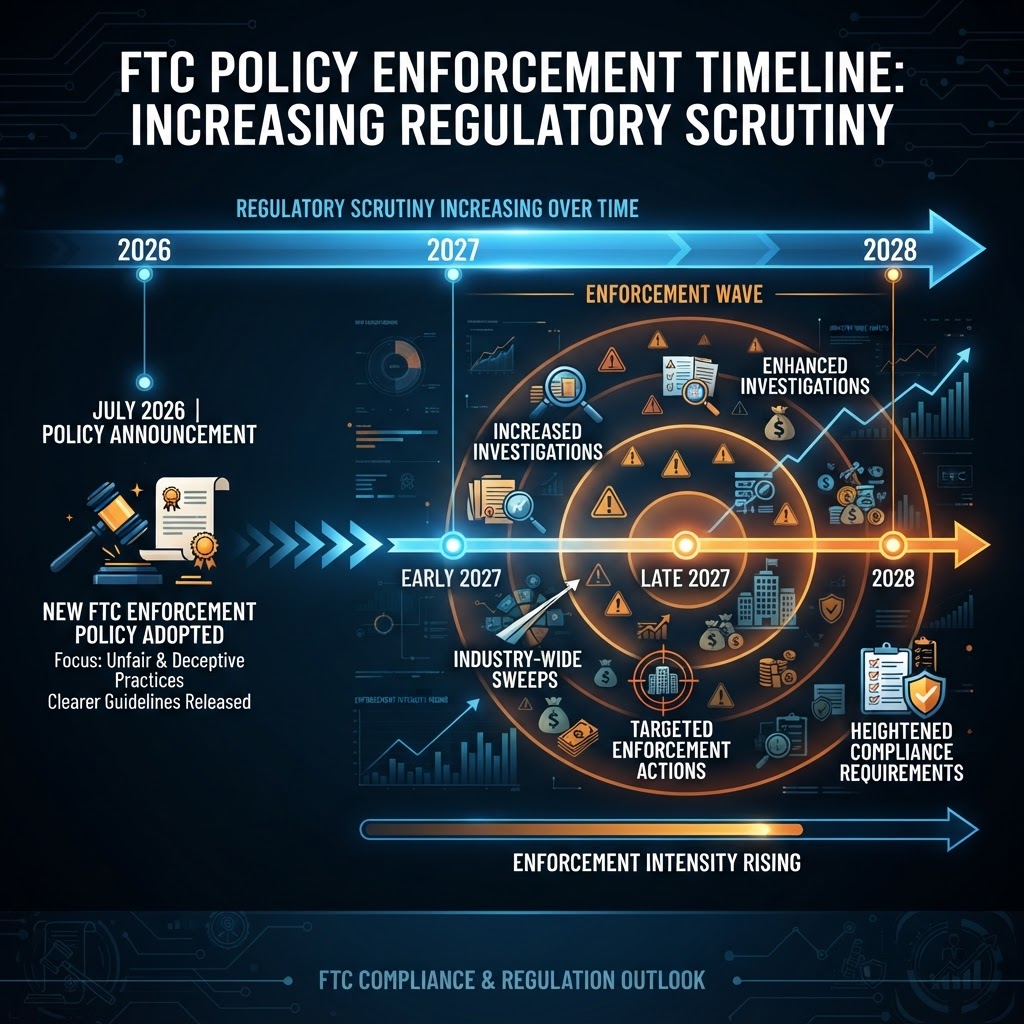
Expect regulatory scrutiny to accelerate over the next 18 months.
FAQ
Yes. The FTC has already started AI enforcement actions against companies for misleading AI claims and false accuracy representations. This new policy statement signals the direction. Expect investigations to ramp up in 2027 and 2028. Smaller companies will be lower priority, but larger brands running at scale will get scrutinized. Cannabis brands are already a higher-priority target for FTC enforcement.
You probably don't. Most teams don't have the visibility to know. Start by asking your AI vendor: "What training data was this agent built on? What accuracy guarantees does it make? What prohibited claims is it trained to avoid? What audit trail does it create?" If they can't answer, you don't have enough visibility. You need that visibility before deploying at scale.
That's the current workaround, and it doesn't scale. A compliance person can review 50 decisions a week. Your AI agent makes 200 decisions a day. You need technical guardrails built into the agent itself, not just human review of agent outputs.
For most teams: 3 to 6 months of engineering time, plus ongoing tuning. For cannabis brands: add another 2 to 3 months for domain-specific compliance training and testing. It's significant. But it's cheaper than a regulatory enforcement action or a platform ban.
Yes. The teams that are scaling AI agents responsibly are investing in compliance infrastructure now. They're documenting their training data. They're testing for prohibited claim generation. They're building audit trails. They're also the teams that will survive FTC scrutiny. The teams that aren't building this infrastructure are running on borrowed time.
Inventory your AI systems. Document what they're trained on. Ask your vendors for compliance guarantees. If you're in cannabis, audit your agent against state-specific regulations. Read more about AI attribution challenges and measurement gaps. Then build a roadmap to add compliance guardrails. You don't need to be perfect. But you need to be intentional, documented, and defensible. ---