In This Post
The $500 Billion Gap
Bain Research projects the US agentic commerce market will reach $300 to $500 billion by 2030. That is 15 to 25 percent of all eCommerce sales. McKinsey goes further, estimating agentic commerce could generate up to $1 trillion in orchestrated US retail revenue.
Gartner says 20 percent of digital commerce transactions will run through AI platforms or agents by 2030. Morgan Stanley puts agent-driven sales at 10 to 20 percent of US eCommerce. J.P. Morgan says 25 percent. Every major forecast agrees on one thing: AI agents are about to reshape how people buy.
Adobe Analytics reported 4,700 percent year-over-year growth in AI-driven visits to US retail sites in 2025. During Black Friday, $14.2 billion in global online sales were attributed to generative AI and agents. ChatGPT traffic alone drives roughly 2x as many new customers as traditional search channels, according to Walmart's own data.
Cannabis is not in that pipeline. Not because operators do not want to be. Because the infrastructure will not let them in.

The gap between agentic commerce infrastructure and cannabis retail is not closing on its own.
Why Cannabis Can Not Buy Through AI
Three things block cannabis from agentic commerce. None of them are small problems.
Age verification. Every cannabis purchase in the US requires verifying the buyer is 21 or older. In a dispensary, that means a physical ID scan at the counter. An AI agent shopping on behalf of a consumer can not present a physical ID.
It can not verify the human behind the request is of legal age. This is not a software bug. It is a regulatory wall built into the purchase flow itself.
State licensing. Cannabis can not cross state lines. A consumer in California can only buy from a California-licensed dispensary.
An AI agent that shops across borders, compares prices nationally, and optimizes for the best deal runs directly into this constraint. The agent would need to know not just what the user wants, but what state they are in, whether the dispensary is licensed there, and whether delivery is even legal in their jurisdiction.
Payment processing. Most cannabis transactions still run on cash or specialized payment platforms. Major payment processors will not touch cannabis. AI agents that handle checkout through standard payment rails simply can not complete a cannabis purchase. The agent can recommend a product, but it can not close the loop.
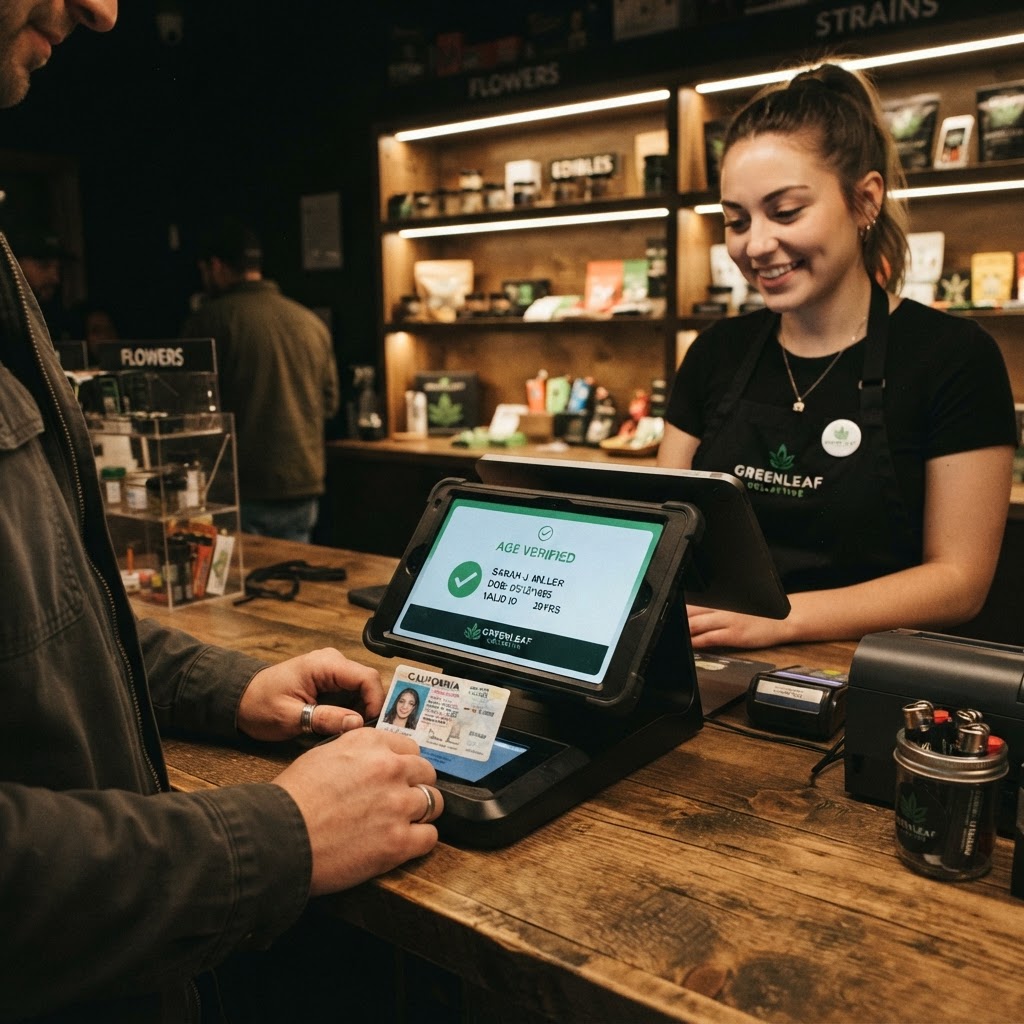
Age verification at the counter: the physical checkpoint AI agents can not replicate.
The Schedule III rescheduling conversation does not fix this. Moving cannabis from Schedule I to Schedule III changes federal drug classification, but it does not override state-level commerce restrictions, dispensary licensing rules, or payment processor policies.
The cannabis compliance paradox around AI has always been about layers of regulation that compound, not a single barrier you can remove.
Kearney estimates 60 percent of shoppers expect to use AI agents within the next 12 months. That adoption wave will sweep through groceries, electronics, household goods, and subscriptions. Cannabis will watch from the sidelines.
Where the Infrastructure Breaks
The problem is not that AI agents refuse to shop for cannabis. It is that the entire transaction stack breaks down when you try to make it work.
Consider what a standard agentic commerce flow looks like. An AI assistant receives a shopping request, searches product catalogs, compares prices across retailers, selects the best option, handles checkout, and completes the purchase. The consumer gets a confirmation. Done.
Now try that with cannabis.
The agent searches for a product. Cannabis products are restricted on most major marketplaces. Amazon does not list them. Google Shopping limits cannabis product visibility. The agent would need to query dispensary-specific menus, which are often behind age gates that block automated access.
The agent tries to verify the buyer. It can not. No digital identity standard in the US verifies age for cannabis purchases. DISA provides background screening and drug testing compliance, but there is no equivalent infrastructure for AI-driven age verification at point of sale.
The agent tries to pay. Standard payment processors decline cannabis transactions. Even with Schedule III, most processors have not updated their cannabis policies. The agent would need access to cannabis-specific payment platforms like CanPay or AeroPay, which require their own enrollment and verification flows.

AI shopping assistants can recommend products all day. Closing a cannabis transaction is a different story.
The agent tries to arrange delivery or pickup. Delivery regulations vary by city and state. Some jurisdictions allow delivery, others do not. The agent would need to check local delivery rules for every order, which no current AI shopping system does.
None of this is impossible to fix. But nobody is building the fix. The cannabis AI visibility gap already costs brands discovery in AI search. The agentic commerce gap will cost them transactions next.
What Smart Operators Are Doing
Some operators are not waiting. They are building infrastructure that makes them ready when the barriers come down.
Age-gated digital menus. Dispensaries using Jane Technologies or Dutchie have age-gated online menus that already integrate with point-of-sale systems.
When digital age verification standards mature, these platforms will be first in line to connect with AI agents. If your dispensary does not have a digitized, API-accessible menu, that is step one.
Cannabis-specific payment integration. Platforms like CanPay, AeroPay, and Hypur are building payment rails that work within cannabis compliance constraints.
Operators who integrate these now will be ready to accept agent-driven payments when the infrastructure catches up. The dispensary SEO operator guide covers how to make your digital storefront discoverable, but discoverability without purchase capability is a leaky funnel.
Local SEO and AI visibility. If an AI agent can not buy cannabis yet, it can still recommend it.
Agents that help consumers research products, compare strains, and find nearby dispensaries are already running. Operators who invest in local cannabis SEO and AI visibility now will be the ones agents surface when a consumer asks "where can I buy flower near me.
Data infrastructure. Agentic commerce runs on structured data. Product catalogs, pricing, inventory, store hours, and location data need to be clean, current, and machine-readable.
If your dispensary data lives in a PDF menu or an unstructured Instagram post, no agent can work with it. The AI automation playbook covers how to start building that infrastructure.
According to McKinsey, agentic commerce will grow fastest in "recurring, low-risk categories such as groceries and subscriptions." Cannabis is neither recurring in the traditional sense nor low-risk from a regulatory standpoint. But the consumer behavior shift is happening regardless.
People will ask AI agents to help them find cannabis. Whether the agent can complete the purchase depends on infrastructure that does not exist yet.
FAQ
No. AI agents can not complete cannabis purchases because they can not verify age, process payments through standard rails, or handle state-specific delivery regulations. The entire transaction stack is blocked.
Not directly. Rescheduling changes federal drug classification but does not override state commerce restrictions, dispensary licensing rules, age verification requirements, or payment processor policies. The barriers to agentic cannabis commerce are structural, not scheduling-based.
Build API-accessible digital menus, integrate cannabis-specific payment platforms, invest in local SEO and AI visibility, and ensure all product data is clean and machine-readable. The operators who build this infrastructure now will be first in line when agentic commerce opens up.
Bain Research projects the US market at $300 to $500 billion by 2030. McKinsey estimates up to $1 trillion in orchestrated US retail revenue. Gartner says 20 percent of digital commerce transactions will run through AI platforms by 2030.
Yes, and they already do. AI agents can surface dispensary locations, compare product types, and provide strain information. The barrier is transaction completion, not discovery. Operators should focus on being visible in AI search results even if purchases are not yet possible.
Cannabis-specific payment platforms like CanPay, AeroPay, and Hypur operate within regulatory constraints. Standard processors like Stripe and PayPal do not serve the cannabis market. Integration with these specialized platforms is a prerequisite for any future agent-driven purchasing.